
Vibecoding Vibes
A few weeks ago we presented at the NCEO Forum in Philadelphia, leading an “AI Idea Sprint” on how organizations can incorporate generative AI into their workflows. As Trevyr and I and our colleague Mark Brennan from Pariveda Solutions prepared for the session, we had what seemed like a brilliant idea: why not build an AI-powered chatbot that attendees could actually use during the presentation? A living, breathing example of AI in action that could help people brainstorm ways to use these tools in their own work.
The problem? We know basically next to nothing about coding.
But I decided to enter the wild world of “vibecoding”—that magical space where enthusiasm meets AI tools, and somehow, things get built. What followed was a three-day adventure that taught me as much about the art of choosing the right tool as it did about the reality of getting AI creations into the real world.
The Dream: Building Something Beautiful
I started with Gemini, Google's AI assistant, and the experience was exciting. Within minutes, I had a clean, professional-looking chatbot interface. The design was exactly what I had envisioned: a sleek "AI Workflow Assistant" with two main sections—a chat interface where users could ask questions, and an "Inspiration" tab loaded with practical examples.
The inspiration cards were perfect: Email Drafting, Content Creation, Data Analysis, Project Planning, Simplifying Concepts, and Code Generation. Each card included helpful descriptions that would give users concrete starting points for conversations with the AI.
Above all, it actually worked on Google’s preview. I could chat with it, click through the examples, and imagine exactly how attendees at the forum would use it during my presentation…
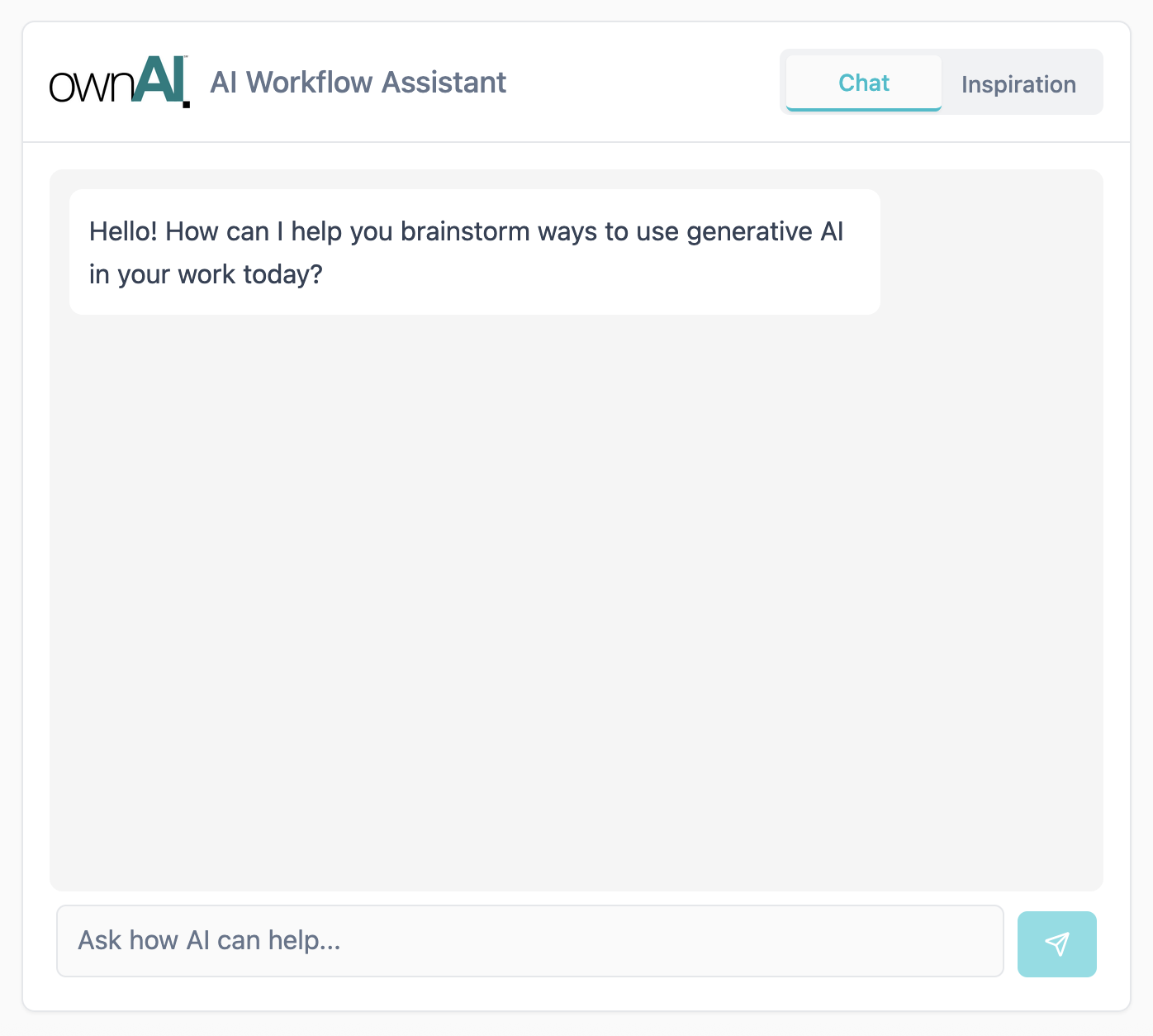
This image is as interactive on our website as that initial chatbot was… Ruh roh.
The Reality: Several Days of Hair-Pulling
Then came the moment when I tried to embed this beautiful creation into our website.
What should have been a simple copy-and-paste operation turned into two days of digital agony (okay, I’m being dramatic - a few hours over several days). Still, I created a Gemini API key. I started a Firebase account and project. I found myself typing mysterious commands into Terminal on my Mac.
No luck.
I asked Claude for help. Nothing. I consulted ChatGPT, which seemed to get me closer, until it didn’t. I finally managed to get the Firebase project to deploy—whatever that means—but the chatbot still never worked on our site.
There's something uniquely frustrating about being so close to your goal as to nearly touch it, yet being unable to bridge that final gap between "it works in the sandbox" and "other people can actually use it."
The Breakthrough: Sometimes the Right Tool Changes Everything
By day three, with my hair probably thinner and my patience exhausted, I remembered Lovable. I'd heard good things about it as a platform specifically designed for people like me—enthusiastic non-coders who want to build things people can actually use.
I gave it a shot. And five minutes later, I had a working prototype.
I'm not exaggerating. I gave Lovable basic instructions about what I wanted the chatbot to do, shared screenshots of my Gemini design (which I still liked), and after a fairly short back-and-forth conversation, it put everything together. The design was nearly identical—I had to re-upload our logo and do a bit of cleanup on the sizing and headers, but that took maybe another fifteen minutes.
More importantly, the entire process of design and getting it deployed and embedded on our Squarespace site took about thirty minutes total, including the time to make sure our OpenAI API key (which Lovable taught me how to create) was stored securely.
Is it the perfect AI chatbot? No. Were there tweaks I was making up to a few minutes before our presentation? Perhaps. But from my initial testing and the feedback we got, the chatbot actually provided helpful suggestions and it was accessible to use from web or mobile. It may not be as impressive as one of the frontier models like ChatGPT, Claude, or Gemini in their direct interface, but heck, it works.
Takeaways
This adventure changed how I think about evaluating AI tools. The question isn't just "what can this tool build?" but "how easily can I get what this tool builds into the hands of the people who need to use it?"
For vibecoding projects, this means considering the entire workflow: ideation, creation, iteration, deployment, and maintenance. I can imagine a future workflow where I use Gemini or Claude to mock up and refine ideas, then transfer those concepts to Lovable for the actual building and deployment. Each tool could play to its strengths, rather than forcing one to handle tasks it wasn't really designed for.
We're in an era where the line between "user" and "creator" is blurring rapidly. Vibecoding represents this new frontier where creativity and the right AI tools can combine to build genuinely useful things.
There’s always a chance you may be setting yourself up for some (additional) gray hairs. But if you stay curious and avoid the occasional urge to headbutt your laptop, I’m confident you can do this.