
The Financial Literacy Challenge Many Employee-Owned Companies Face (And How AI Can Help)
Picture this: it’s annual meeting time at an employee-owned company. The CEO walks through the valuation report, explains how revenue growth drove a 12% increase in share value, and then she watches the room.
A few seasoned employees nod along. But some or maybe even most of the others look politely lost.
Unfortunately, financial concepts that can drive an employee-owned company's success (like EBITDA, working capital, operating cash flow, etc) were designed for accountants and finance pros, and not for the rest of us.
And yet, for employee ownership to mean something beyond a line item on a benefits statement, everyone needs to understand how their daily work connects to those numbers.
The good news? AI can help.
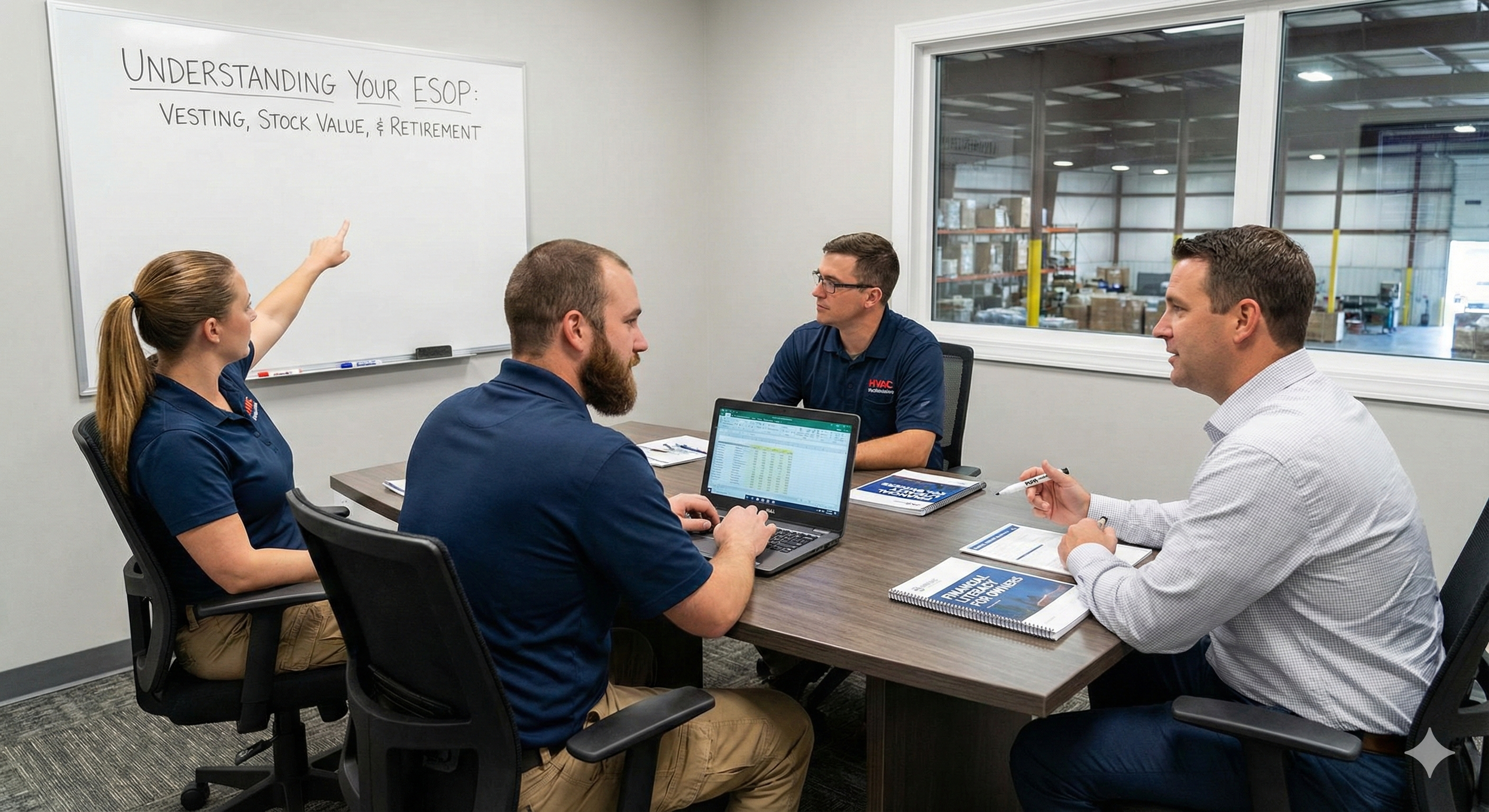
Why Financial Literacy Matters
In a traditional company, employees often do their jobs without ever understanding the P&L statement. In part, that can be a choice by company leaders, who believe they must keep the financial performance of the business a secret because of delicate issues like compensation, or because they don’t believe employees could understand the numbers anyway.
Employee ownership changes that equation. When someone owns a stake in the company, their actions connect directly to outcomes they care about and have an actual stake in—retirement savings, wealth building, job security. But that connection only motivates when workers understand it. A warehouse worker who grasps how reducing damaged inventory affects profitability (and share value) sees their work differently than one who doesn't.
Where Traditional Approaches Fall Short
Most employee-owned companies try annual meetings, printed ESOP materials, and occasional lunch-and-learns. These efforts matter, but they struggle with persistent problems:
One-size-fits-all doesn't fit anyone well. The explanation that resonates with your accounting team may sail by your field technicians. The simplified version for new hires feels patronizing to veterans.
Information delivery isn't understanding. You can present numbers accurately and still have the room walk away confused. Real understanding requires engagement and the ability to ask questions without embarrassment.
Good content traditionally takes time nobody has. Creating genuinely engaging educational materials—videos, interactive content, role-specific explanations—at least historically has required resources most employee-owned companies couldn't spare.
How AI Changes the Game
AI won't replace the human connections that make ownership culture work. But it can help you create, personalize, and scale the educational content that supports those connections.
Personalizing by Role and Experience
Instead of one explanation of share value for everyone, imagine generating versions tailored to different audiences. A version for sales that connects customer retention to valuation. A version for manufacturing that emphasizes equipment efficiency. A version for new hires that starts from scratch, and one for tenured owners going deeper.
AI helps you create these variations in a fraction of the time. You provide the core concepts; AI helps translate them into language that resonates with each group.
Turning Concepts into Engaging Formats
The same financial concept can be a wall of text, a three-minute video, or an interactive quiz. AI makes it dramatically easier to create multiple formats from the same source.
Take the repurchase obligation—something maturing ESOPs need employees to understand, and something almost nobody finds intuitive. With AI, you can generate a video script, create a podcast-style explainer, build an interactive calculator, or develop quiz questions that reinforce learning. You still need human oversight, but the drafting and iteration gets much lighter.
One powerful development is interactive learning experiences. Instead of a static FAQ, imagine a chatbot trained on your specific ESOP documents and company financials. Employees ask questions in plain language—"How does our share price get determined?"—and get accurate answers specific to your plan.
This extends your HR team rather than replacing them. Employees get immediate answers to common questions; your team focuses on conversations needing a human touch.
Getting Started
You don't need to try everything at once. Start with one pain point:
Employees struggle with annual statements? Use AI to create a plain-language companion document.
New hire orientation feels stale? Generate a short video or interactive module.
Same questions keep coming up? Build an AI-enhanced FAQ or simple chatbot.
Financial updates aren't connecting? Create role-specific versions that translate company numbers into terms each department cares about.
The best starting point is the communication challenge frustrating you most right now.
The Human Element Remains Central
AI is a tool that can amplify human effort, but the trust and shared purpose that define ownership culture come from people.
What AI does is remove friction. When creating content takes hours instead of days, you can create more of it and make it more personalized. When employees get answers without waiting for a meeting, your team has time for the conversations that matter most.
The goal isn't adopting AI for its own sake—it's strengthening the ownership culture you're already building.