
Owning the Future: Reflections from the Future of Equity Symposium
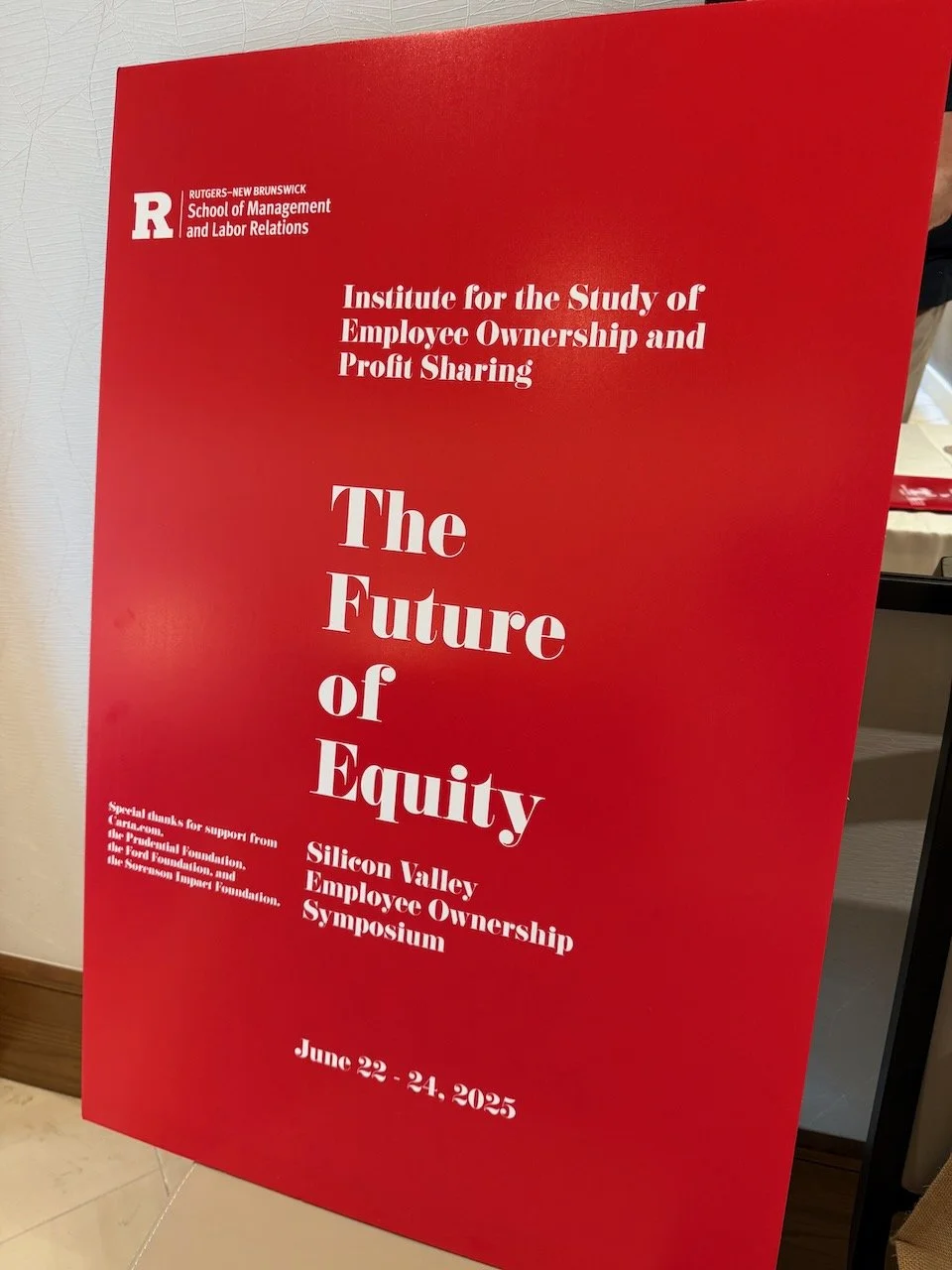
This week, I attended the Future of Equity Symposium, hosted by Rutgers University’s Institute for the Study of Employee Ownership and Profit Sharing in Palo Alto, CA.
I was honored to be there to facilitate a discussion on the opportunities and implications of artificial intelligence for the employee ownership movement. We had a great conversation with a group of thoughtful, dedicated practitioners and scholars who shared insights on the challenges and opportunities AI presents to employee-owned companies..
What struck me in the discussion – and in all the discussions I heard – was just what a remarkable community of people this is who have dedicated their careers to expanding broad-based ownership.
One of the great things about the employee ownership world is you can actually meet your heroes, and they invariably turn out to be even more impressive in person. For instance, I had the unexpected pleasure of sharing a train ride with Corey Rosen, a true dean of the EO community and an unfailingly generous and thoughtful mentor for so many. Getting to talk with him about his work, AI, and the exciting state of employee ownership research today was special for me. And he even made sure I got off at the right BART stop. (ha)
The AI Challenge and the Ownership Opportunity
During my talk, "Owning AI: Generative AI's Opportunities and Implications for Employee Ownership," I posed a provocative scenario to the group: imagine a future where a company reaches unicorn status—a billion-dollar valuation—with just one employee orchestrating swarms of AI agents. While this might excite some Silicon Valley futurists, it raises profound questions about the future of work, economic security, and equity.
The core argument I presented is that while we can't predict AI's long-term trajectory, employee-owned firms have distinct advantages in adopting and operationalizing generative AI right now. This isn't just wishful thinking; it's grounded in both research and the fundamental dynamics of ownership culture.
Why Employee Ownership Matters More Than Ever
The discussion that followed touched on several critical themes that emerged from the talk:
The Universal Basic Capital Alternative: Rather than settling for Universal Basic Income as a band-aid for AI-driven displacement, we discussed the transformative potential of Universal Basic Capital, as recently argued to great effect by Saffron Huang and Sam Manning. The idea is to give people ownership stakes in the wealth-producing mechanisms of the future. Employee ownership represents a proven model for this approach, distributing not just income but actual assets that grow with productivity.
The Adoption Gap: McKinsey's finding that 91% of workers use AI tools personally while only 13% of companies have deployed more than one AI use case reveals a massive organizational challenge. Fear and misaligned incentives explain much of that gap. Employees worry that demonstrating AI's time-saving potential will lead to their replacement. But in employee-owned firms, the calculus changes.
Ownership Culture as Competitive Advantage: Employee-owners have job security, trust, and a direct stake in productivity gains, which leads to greater productivity than at conventionally owned firms. (In fact, a groundbreaking research paper documenting the increased productivity of EO firms was given at the Symposium by Eric Hoyt, Fidan Kurtulus, Joseph Blasi, Doug Kruse, and Bill Castellano - more on that to come.) For employee-owners, when the company pie grows through AI-powered efficiency, each owner's slice grows too. This alignment creates powerful incentives for collaborative AI adoption rather than defensive resistance.
Facing the future: When thinking about where this all goes, I often come back to Amara's Law, that we tend to overestimate technology's short-term effects and underestimate its long-term impact. I think it is critical to recognize the urgency and opportunity before us. If we act now, the employee ownership movement has time to prepare and to adopt AI intelligently and ethically while building their people's capacity.
The Power of Community
The conversations at the Future of Equity Symposium reinforced my conviction that employee ownership isn't just a nice-to-have in the AI age. If we want machines to work for us rather than instead of us, and if we want a system that rewards work and human agency, then broad-based employee ownership becomes not a luxury but a necessity.
I have to say that seeing this community of thoughtful, committed individuals in action gives me hope. Together, it’s a group that’s not just theorizing about a better future—they (we) are building the structures and culture to make that future possible.