
Employee-Owned Companies Should Have an AI Advantage. But It Won’t Happen on Its Own.
Many companies adopting AI face the same set of challenges: employees who don’t trust the technology, leaders who roll it out without input from the people it affects, training that’s too shallow to stick, and no clear reason for workers to care whether it succeeds.
We recently published a peer-reviewed article in the International Review of Applied Economics that asks a straightforward question: do employee-owned companies — specifically, ESOP firms — have structural advantages that position them to handle these challenges better than conventionally owned firms?
Read the full article: “Trust, Voice, and Ownership: Why ESOP Firms May Be Better Positioned for AI Adoption”.
The short answer is: yes, on paper.
The article synthesizes two bodies of research that don’t usually talk to each other — the AI adoption literature and the employee ownership literature — and finds that they converge on four organizational factors:
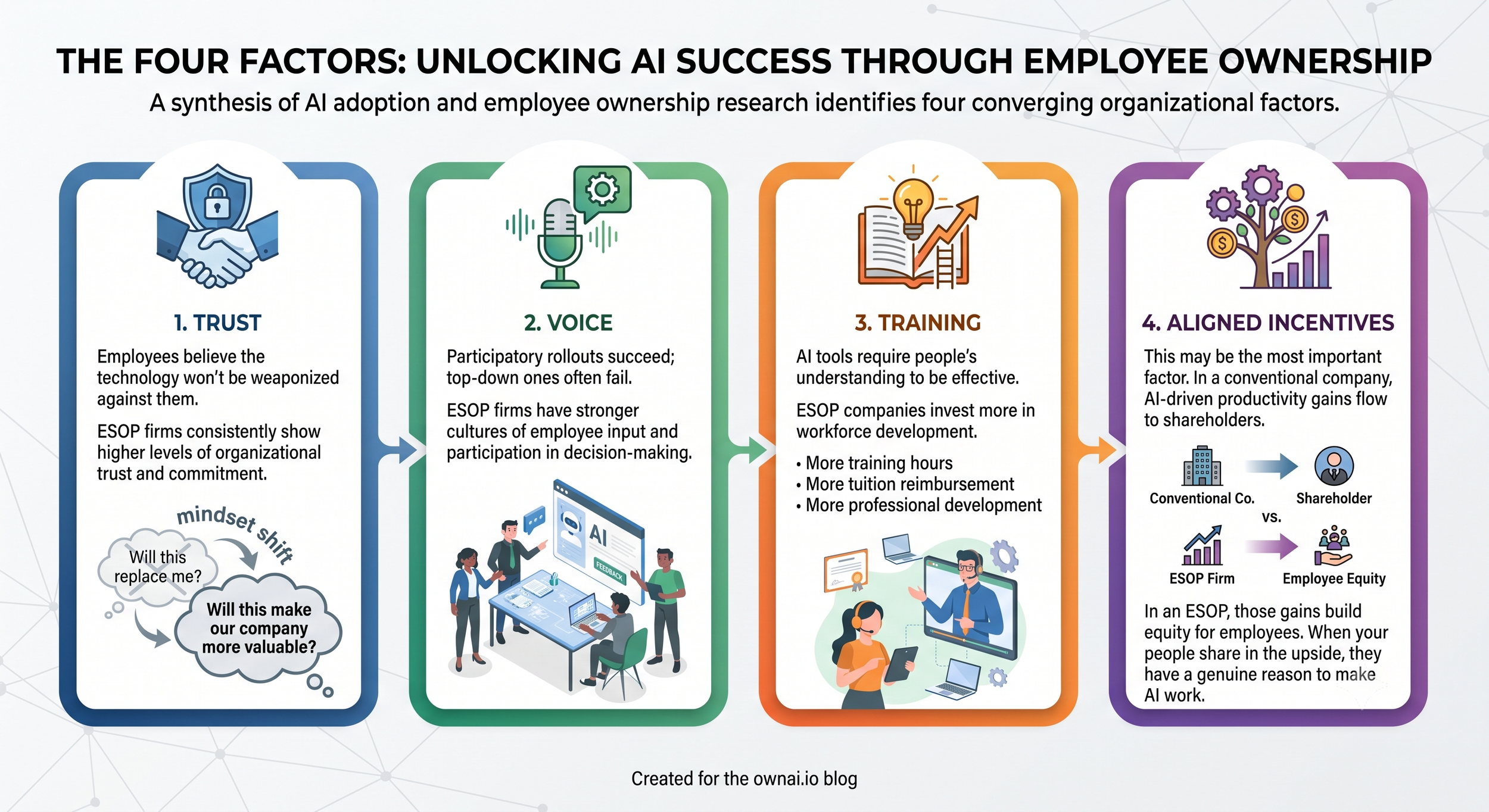
Trust. Successful AI adoption depends on employees believing the technology won’t be weaponized against them. ESOP firms consistently show higher levels of organizational trust and commitment. When you own a piece of the company, the calculus around a new tool changes. It’s not “will this replace me?” — it’s “will this make our company more valuable?”
Voice. The research on AI implementation is clear: top-down rollouts fail more often than participatory ones. ESOP firms tend to have stronger cultures of employee input and participation in decision-making — exactly the kind of environment where AI adoption is more likely to be shaped by the people who’ll actually use it.
Training. AI tools are only as good as people’s understanding of how to use them. ESOP companies invest more in workforce development than their non-ESOP counterparts — more training hours, more tuition reimbursement, more professional development. That’s a head start when you need your team to build real fluency with new technology.
Aligned incentives. This might be the most important one. In a conventional company, AI-driven productivity gains flow to shareholders. In an ESOP, those gains build equity for the employees themselves. When your people share in the upside, they have a genuine reason to make AI work — not just comply with it.
But here’s the part that matters most for practitioners: having these advantages and activating them are two different things.
An ESOP doesn’t automatically produce a culture of trust. A participatory governance structure doesn’t mean employees are actually being consulted about technology decisions. A training budget doesn’t mean the training is any good, or that it’s pointed at the right skills. And even well-aligned incentives don’t help if no one connects the dots between AI adoption and the share price in their retirement account.
The article is deliberately framed as a theoretical framework, not a guarantee. The research tells us that the ingredients are there. It doesn’t tell us that success follows automatically.
This is the distinction we think about constantly at ownAI. The ESOP companies we work with have real cultural and structural assets that most companies would love to have. But those assets are potential energy, not kinetic energy. They need to be deliberately activated.
Activating these advantages means doing the unglamorous work. It means involving employee-owners early, before you’ve already decided which tools to buy. It means building AI fluency across the organization, not just among the tech-curious. It means making the connection between AI adoption and ownership value explicit, not assumed.
And it means taking stock of where your ownership culture is strong and where it’s aspirational. Not every ESOP company has a robust culture of participation. Some have the legal structure of employee ownership without the lived experience of it. The structural advantage only kicks in when the culture is real.
AI adoption is accelerating, and the companies that figure it out first will have a meaningful competitive edge. The argument in the article isn’t that ESOP firms will automatically win this race. It’s that they’re starting from a better position — if they choose to run it deliberately.
That “if” is the whole ballgame. And that’s where ownAI is built to help.