
An employee at a distribution company used to build his company’s marketing dashboard by hand, pulling numbers from multiple sources. Then he took two of our AI fluency workshops and learned to work with AI in plain language. One afternoon, with a few prompts, he had AI build the dashboard for him, insights included. The time he used to spend building it now goes to decisions that grow the business.
We see this time and time again. Building a custom solution to a problem like his is no longer an IT project. He knew where his time was going, he learned enough to do something about it, and his job evolved.
This is how we see most jobs evolving with AI. It will happen one task at a time, led by the people doing the work. We believe employee-owned companies have a head start here, because a win like his belongs to everyone. That head start pays off when leaders build on it deliberately.
Why employee-owners should lead
“AI is going to change your job” can sound scary. It sounds different when you’re the one deciding how.
We believe employee-owners are well placed to lead that evolution, for three reasons.
They know the work. They see the pain points every day, including the ones that are invisible from the top.
They can describe it. With generative AI, you explain what you need in plain language, the way you’d explain it to a colleague. The people who know the work best can now reshape it themselves.
They have a reason to act. As owners they gain twice, with more engaging work and a share of the growth.
That third reason matters more than it might seem. Two USC researchers, who have also written on the topic in Harvard Business Review, surveyed 604 U.S. employees who use AI at work every day. What stands out is that almost a third of them kept AI knowledge or techniques from coworkers or their employer. Fear of being replaced was one of the reasons they gave.
Ownership changes that. When an employee-owned company does well, its owners do too, so people have a reason to share what’s working.
Empower employee-owners to reshape their work
Job evolution isn’t a one-time redesign. It’s a series of ongoing experiments. People try new AI-enabled ways of doing their work, and the company captures the ones that create real value. My partner Michael Zimmer’s peer-reviewed research points to four strengths that ESOP companies tend to have. They are worker voice, a high-trust culture, shared upside, and investment in training. Together they create a real opportunity. When those strengths are in place, people feel safe to experiment, they speak up about what’s working and what isn’t, and they share in the gains they create.
Here’s how you can put that opportunity into practice. Your HR or people team provides AI training, so employee-owners can become familiar with the tools. Then they start experimenting and reshaping their work, and what works gets shared. From there, HR makes those changes official. The process keeps moving as AI tools evolve and your people keep experimenting.
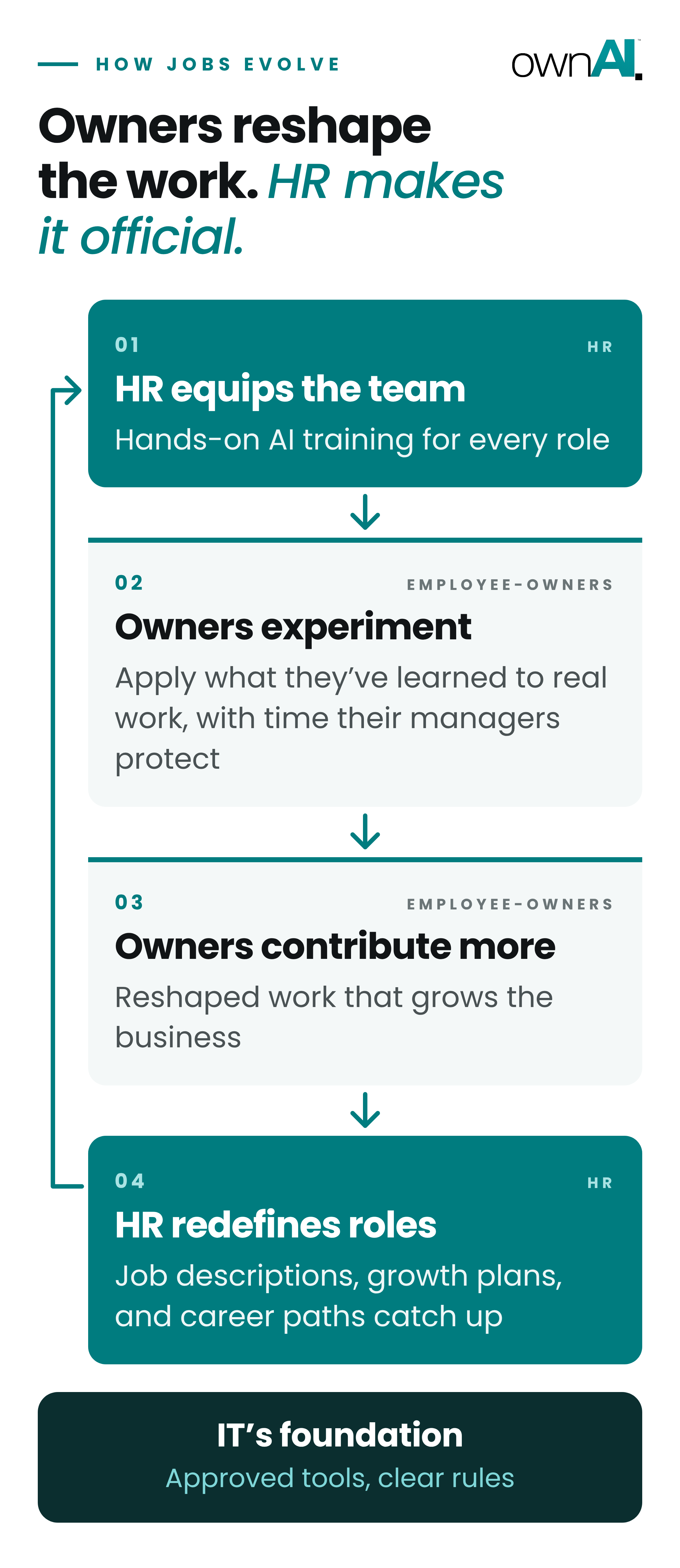
HR equips the team. Give everyone hands-on AI training. People can’t reshape their work with tools they haven’t learned to use. Training should build comfort, trust, and fluency with the tools.
Owners experiment. Ask managers to protect time for people to apply what they’ve learned to their real work. People experiment when it feels safe, and ESOP companies’ long record of keeping their people through downturns helps make “augment, not replace” believable.
Owners contribute more. Give people a way to share what they build. Many ESOP companies already have the channels, like team huddles and committees, where one person can show the next what’s working. When that reshaped work grows the business, every owner benefits.
HR redefines roles. Update job descriptions, growth plans, and career paths as the work evolves. Think back to the dashboard. His job now includes decisions that grow the business, and HR’s role is to make that official.
Your IT team provides the critical foundation, with approved tools and clear rules so people can experiment safely. A study of about 25,000 Danish workers in jobs highly exposed to AI shows how much that matters. With encouragement, enterprise tools, and training from their employer, 93% of workers had used AI chatbots at work. With no AI policy, 41% had.
Much of this is exactly what HR is built to do. Yet SHRM, the Society for Human Resource Management, found that 52% of organizations don’t involve HR in shaping their overall AI strategy. We believe employee-owned companies can lead here, with HR and IT working as partners.
Make training your launch pad
All of this starts with training. The goal is to give your people the skills and confidence to reshape their own work, so how you design it matters. Build it around real tasks, and have people learn together. Participants in our programs tell us that learning from their peers is what helps most.
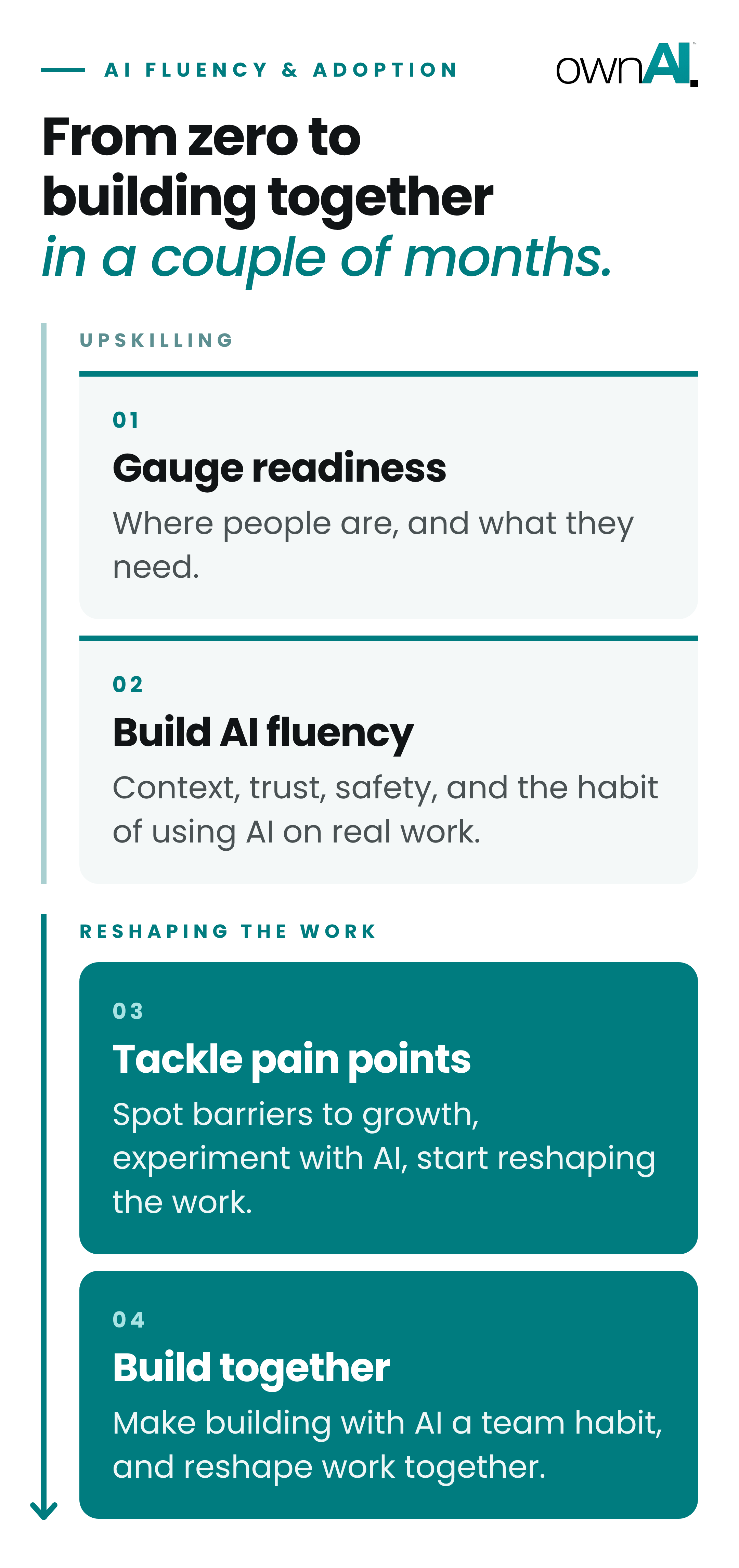
Our AI Fluency & Adoption Program is built on these lessons. It’s designed to help every employee-owner, not just a few early adopters, go from trying AI to creating real value with it. A big part of that is building the habit. Small, steady practice on real work is what changes how people work. The program moves through four steps over a couple of months. We gauge readiness, build AI fluency, and then support employee-owners in tackling their pain points and building AI solutions together. Here’s what that looks like.
We’d love to hear how you’re approaching AI training at your company. And if you’re curious what our AI Fluency & Adoption Program could look like for your people, write to us at team@ownai.io.
At ownAI, we help employee-owned companies upskill their teams and put AI to work. This post grew out of a session we led at The ESOP Association’s Employee Owned 2026 conference.